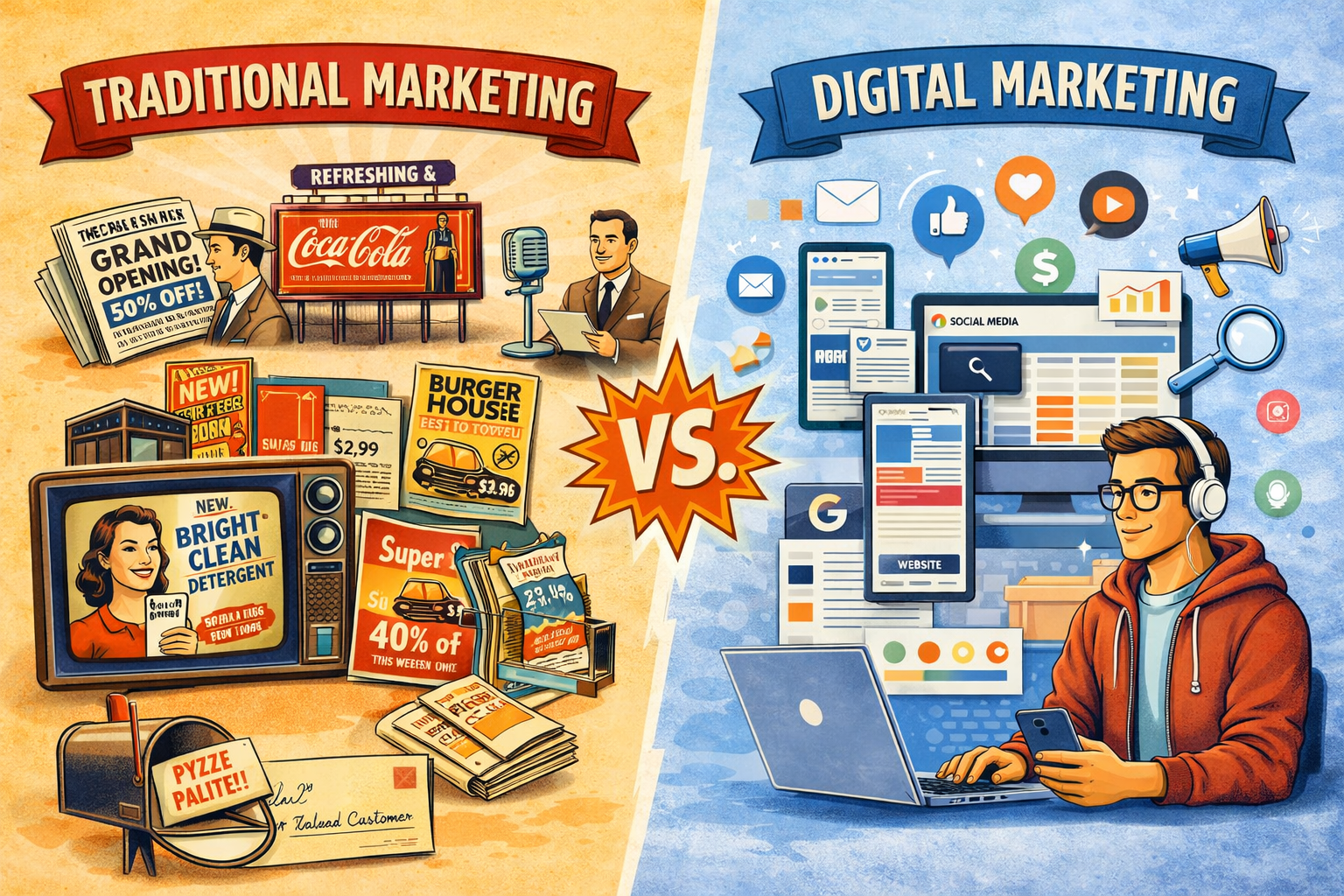
When comparing digital marketing vs traditional marketing, businesses need to understand which strategy delivers better results, higher ROI, and wider audience reach.In today’s competitive market, digital marketing has become the preferred choice for B2C brands due to its cost-effectiveness, targeting capabilities, and measurable performance.
In this article, we will explore 7 proven differences between digital marketing vs traditional marketing to help you choose the best strategy for your business.
Contents
- 1 What is Traditional Marketing?
- 2 Advantages of Traditional Marketing
- 3 Limitations of Traditional Marketing
- 4 What is Digital Marketing?
- 5 Benefits of Digital Marketing
- 6 7 Powerful Differences Between Digital Marketing vs Traditional Marketing
- 7 Digital Marketing vs Traditional Marketing: Which is Better for B2C Brands?
- 8 When Traditional Marketing Still Works
- 9 Final Verdict: Which Strategy Should You Choose?
- 10 Conclusion
- 11 Frequently Asked Questions
- 11.1 1. What is the main difference between digital marketing and traditional marketing?
- 11.2 2. Which is more effective: digital marketing or traditional marketing?
- 11.3 3. Is traditional marketing still relevant today?
- 11.4 4. Why is digital marketing better for B2C brands?
- 11.5 5. Can businesses use both online and offline marketing together?
- 11.6 Need Help Growing Your B2C Brand with Digital Marketing?
What is Traditional Marketing?
Traditional marketing refers to conventional promotional methods that businesses have used for decades to reach their audience. These marketing techniques are usually offline and focus on mass communication.
Some common examples of traditional marketing include:
- Television advertisements
- Radio commercials
- Newspaper ads
- Magazine promotions
- Billboards and hoardings
- Flyers and brochures
- Direct mail campaigns
offline marketing is still widely used by many brands, especially for creating local awareness and reaching broad audiences.
Advantages of Traditional Marketing
Traditional marketing still offers several benefits for businesses, especially in specific markets and demographics.
1. Builds Strong Local Brand Recognition
Offline marketing methods such as banners, flyers, and newspaper ads are highly effective for local businesses that want to build awareness in a specific area.
2. Trusted by Older Audiences
Many older consumers still rely on newspapers, television, and radio for information. This makes traditional marketing useful for brands targeting those age groups.
3. Effective for Mass Reach
TV ads, radio, and billboards can reach a large number of people quickly, making them useful for brand awareness campaigns.
Key Benefits of Traditional Marketing
- Builds strong local brand recognition
- Trusted by older audiences
- Effective for mass reach
Limitations of Traditional Marketing
Although offline Marketing has strengths, it also comes with several limitations.
1. Limited Audience Targeting
Traditional marketing does not allow businesses to target audiences based on age, location, interests, or online behavior as accurately as digital marketing.
2. Expensive
Television ads, print media, and billboard advertising can be costly, especially for small and medium-sized businesses.
3. Difficult to Measure Performance
It is hard to know exactly how many people saw your ad, engaged with it, or became customers because of it.
What is Digital Marketing?
Digital marketing, also referred to as online marketing, involves promoting products or services through online channels and digital platforms. It helps businesses reach their target audience more effectively and track results in real time.
Common types of digital marketing include:
- Search Engine Optimization (SEO)
- Social Media Marketing
- Content Marketing
- Email Marketing
- Pay-Per-Click Advertising (PPC)
- Influencer Marketing
- Video Marketing
Digital marketing has become essential because modern customers spend a large amount of time online.
Benefits of Digital Marketing
Digital marketing offers many advantages for B2C brands looking to grow faster and smarter.
1. Better Audience Targeting
Businesses can target customers based on age, interests, online behavior, location, and purchasing habits.
2. Cost-Effective
Compared to traditional marketing, digital campaigns can be launched with smaller budgets, making them ideal for startups and growing businesses.
3. Real-Time Performance Tracking
With tools like Google Analytics, meta business suite and social media insights, businesses can measure clicks, traffic, conversions, and engagement in real time
4. Higher Customer Engagement
Digital platforms allow brands to directly interact with customers through comments, messages, likes, and shares.
5. Global Reach
Businesses can reach customers beyond their local area and even expand internationally using digital channels.
7 Powerful Differences Between Digital Marketing vs Traditional Marketing
To understand digital marketing vs traditional marketing clearly, it is important to compare both methods based on cost, targeting, reach, and performance.
1. Cost in Digital Marketing vs Traditional Marketing
- Digital Marketing: More affordable and flexible
- Traditional Marketing: Usually more expensive
2. Audience Targeting
- Digital Marketing: Highly specific targeting
- Traditional Marketing: Broad audience targeting
3. Performance Tracking
- Digital Marketing: Real-time analytics and measurable data
- Traditional Marketing: Hard to measure accurately
4. Customer Engagement
- Digital Marketing: Interactive and two-way communication
- Traditional Marketing: Mostly one-way communication
5. Reach
- Digital Marketing: Global reach
- Traditional Marketing: Mostly local or regional reach
6. Speed of Campaign Execution
- Digital Marketing: Campaigns can be launched instantly
- Traditional Marketing: Takes more time to plan and execute
7. Return on Investment (ROI)
- Digital Marketing: Better ROI due to measurable and optimized campaigns
- Traditional Marketing: ROI is often harder to track
simple comparison between online Marketing vs offline Marketing:
| Feature | Online Marketing | Offline Marketing |
|---|---|---|
| Cost | Low | High |
| Targeting | Highly specific | Broad |
| Reach | Global | Local |
| Tracking | Real-time | Limited |
Digital Marketing vs Traditional Marketing: Which is Better for B2C Brands?
For modern businesses, the debate between digital marketing vs traditional marketing often ends in favor of digital channels because of better tracking, audience targeting, and customer engagement.
For most modern B2C brands, digital marketing is the better choice. Here’s why:
1. Customer Behavior Has Changed
Consumers today spend more time online—scrolling social media, searching on Google, and watching videos.
2. Better Personalization
Digital marketing allows brands to show personalized ads based on user behavior, interests, and demographics.
3. Higher ROI
Businesses can start with a small budget and scale campaigns based on performance and results.
4. Stronger Engagement
Platforms like Instagram and Facebook allow direct interaction with customers.
When Traditional Marketing Still Works
Traditional marketing is still useful in certain cases, such as:
- Local businesses targeting nearby customers
- Brand awareness campaigns through TV and billboards
- Rural areas with limited internet access
- Businesses targeting audiences who prefer offline media
Final Verdict: Which Strategy Should You Choose?
Instead of choosing one over the other, the smartest approach is often a hybrid marketing strategy.
Use Digital Marketing for:
- Lead generation
- Customer engagement
- Performance tracking
- Online sales growth
Use Traditional Marketing for:
- Local reach
- Brand awareness
- Offline visibility
- Mass audience campaigns
Conclusion
For B2C brands in today’s digital era, digital marketing clearly has the edge because it is more targeted, measurable, affordable, and engaging. However, traditional marketing still has value in certain situations, especially for local awareness and mass visibility.
The best approach is not always choosing one over the other—it is about understanding your audience and using the right mix of strategies to achieve your business goals. Overall, digital marketing vs traditional marketing is not about choosing one blindly, but about selecting the right strategy based on your business goals, customer behavior, and long-term growth plans.
In conclusion, understanding digital marketing vs traditional marketing helps businesses choose the right strategy for growth.
Frequently Asked Questions
1. What is the main difference between digital marketing and traditional marketing?
The main difference is that digital marketing uses online channels like search engines, social media, and websites, while traditional marketing uses offline methods like TV, newspapers, radio, and billboards.
2. Which is more effective: digital marketing or traditional marketing?
For most B2C brands, digital marketing is more effective because it offers better targeting, lower costs, measurable results, and higher engagement.
3. Is traditional marketing still relevant today?
Yes, traditional marketing is still relevant for local awareness, offline branding, and reaching certain demographics, especially older audiences.
4. Why is digital marketing better for B2C brands?
Digital marketing is better for B2C brands because it allows businesses to reach customers where they spend most of their time—online.
5. Can businesses use both online and offline marketing together?
Yes, many businesses use a hybrid strategy to combine the reach of traditional marketing with the targeting and tracking of digital marketing.
Need Help Growing Your B2C Brand with Digital Marketing?
If you want to improve your online visibility, attract the right audience, and generate more leads and sales, the right digital marketing strategy can make a big difference. From SEO and social media marketing to paid advertising and content strategy, choosing the right approach helps your business grow faster and more effectively.
Ready to take your brand to the next level? Contact us today to discuss the best digital marketing strategy for your business.